Exporting accounts
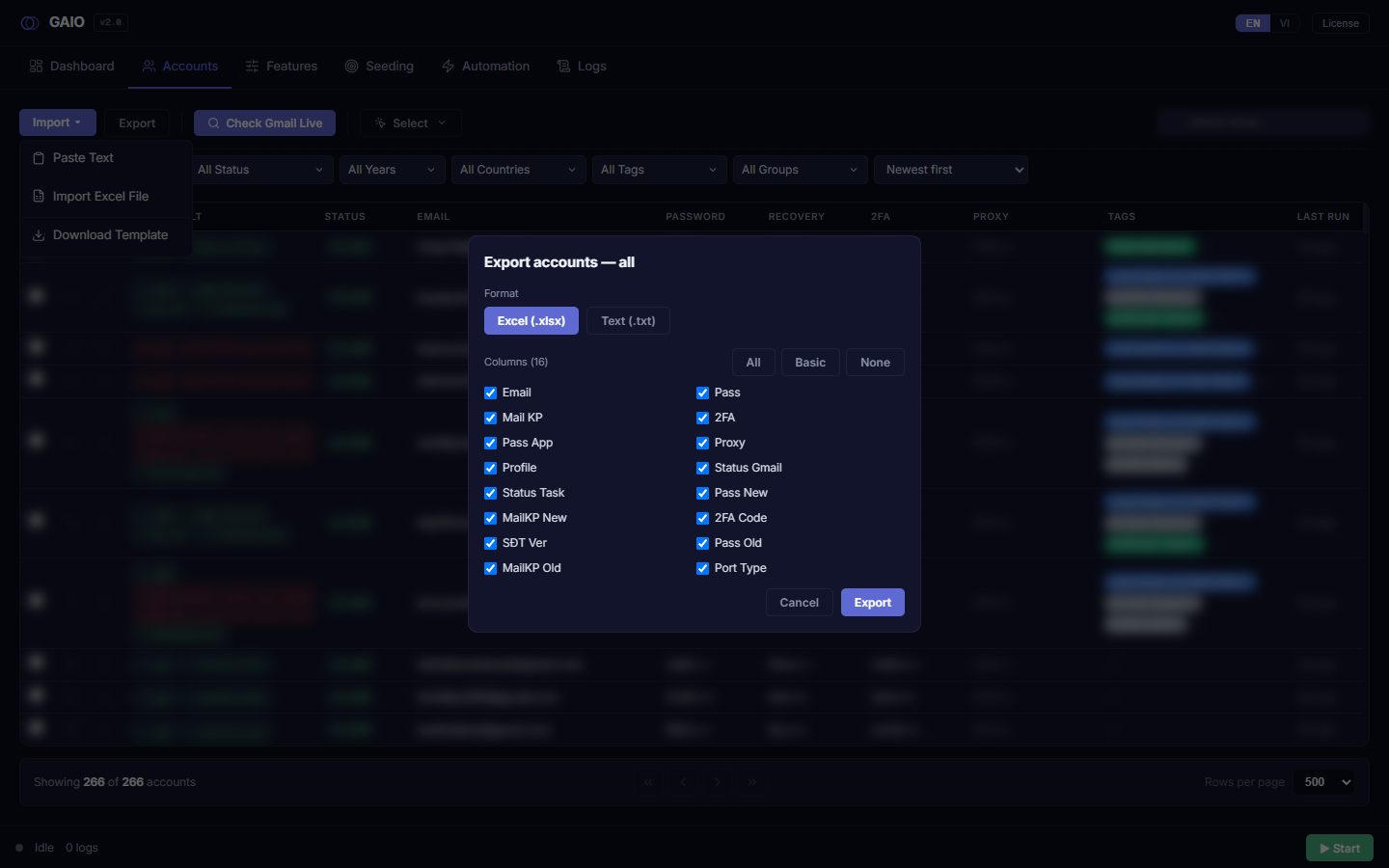
The Export button (a ghost-style button just right of Import on the toolbar) opens a small modal (470px wide) titled Export accounts, letting you export accounts to an Excel or text file with exactly the columns you choose.
Export scope: selected vs all
The scope is decided implicitly by which rows you tick in the table: if any accounts are checked, only those are exported; if none are checked, all accounts are exported. The modal title is the only indicator — it shows "— N selected" or "— all" so you know the scope.
To export a small group, tick those rows before clicking Export, then check that the modal title reads "— N selected".
Format: Excel (.xlsx) or Text (.txt)
- Excel (.xlsx) Default — exports a spreadsheet.
- Text (.txt) — exports a plain-text file. Choosing Text reveals a Delimiter row with preset buttons
|:,Tab;plus a free-text field (max 3 characters, defaults to|). Text mode also shows a Preview line displaying the chosen column labels joined by the delimiter (Tab shown as ⇥).
Choosing columns: All / Basic / None and the 17 columns
Three quick buttons help pick columns: All (every column), Basic (Email, Pass, Mail KP, 2FA only), None (clears all). Below them is the checkbox grid of 17 columns. The table below explains what each means:
| # | Column | Meaning |
|---|---|---|
| 1 | The account's Gmail address. | |
| 2 | Pass | The account's current password. |
| 3 | Mail KP | The recovery email. |
| 4 | 2FA | The 2FA secret key (base32) used to generate two-factor codes. |
| 5 | Pass App | The 16-character app password. |
| 6 | Proxy | The proxy assigned to the account. |
| 7 | Profile | The antidetect (GPMLogin) browser profile name/ID for the account. |
| 8 | Status Gmail | The Gmail live/die status (LIVE / Verify / Disabled). |
| 9 | Status Task | The result of the account's most recent automation run. |
| 10 | Pass New | The new password (after a password change). |
| 11 | MailKP New | The new recovery email (after a change). |
| 12 | 2FA Old | The OLD 2FA secret (base32), saved before changing the Authenticator. |
| 13 | SĐT Ver | The verified phone number (Phone Verified). |
| 14 | Pass Old | The old password (before a change). |
| 15 | MailKP Old | The old recovery email (before a change). |
| 16 | Port Type | The proxy's port type / connection type. |
| 17 | Backup Codes | The 10 login backup codes (space-separated), from Get Backup Codes; each is single-use. |
The column order in the output always follows the standard order in the table above, not the order you ticked them. So you only choose which columns appear — the ticking sequence doesn't matter.
Steps to export accounts
- (Optional) Set the scope — tick the accounts you want; leave none checked to export everything.
- Open the modal — click
Export; check whether the title reads "— N selected" or "— all". - Pick a Format — Excel (.xlsx) or Text (.txt).
- If Text, pick a Delimiter — click a preset (
|:,Tab;) or type a custom one (max 3 characters). - Choose columns — use All / Basic / None or tick individual columns.
- If Text, check the Preview — verify the column-label order on the preview line.
- Export — click
Export; a toast shows the saved file path.
Since 2.0.86: clicking Export opens a Save-As dialog so you pick the folder and file name yourself; the file is then written there and a toast reports the path. Cancel in the dialog skips the export. (Before 2.0.86 the file was always written to the Data folder.)
The Export button is disabled while exporting and when zero columns are selected ("Select at least 1 column"). Clicking the dark backdrop closes the modal (but not while an export is running).